
Affiliate note: Some links on this page are affiliate links. If you book through them, BookOutdoorTrips may earn a commission at no extra cost to you. This does not affect our editorial judgment. Learn more.
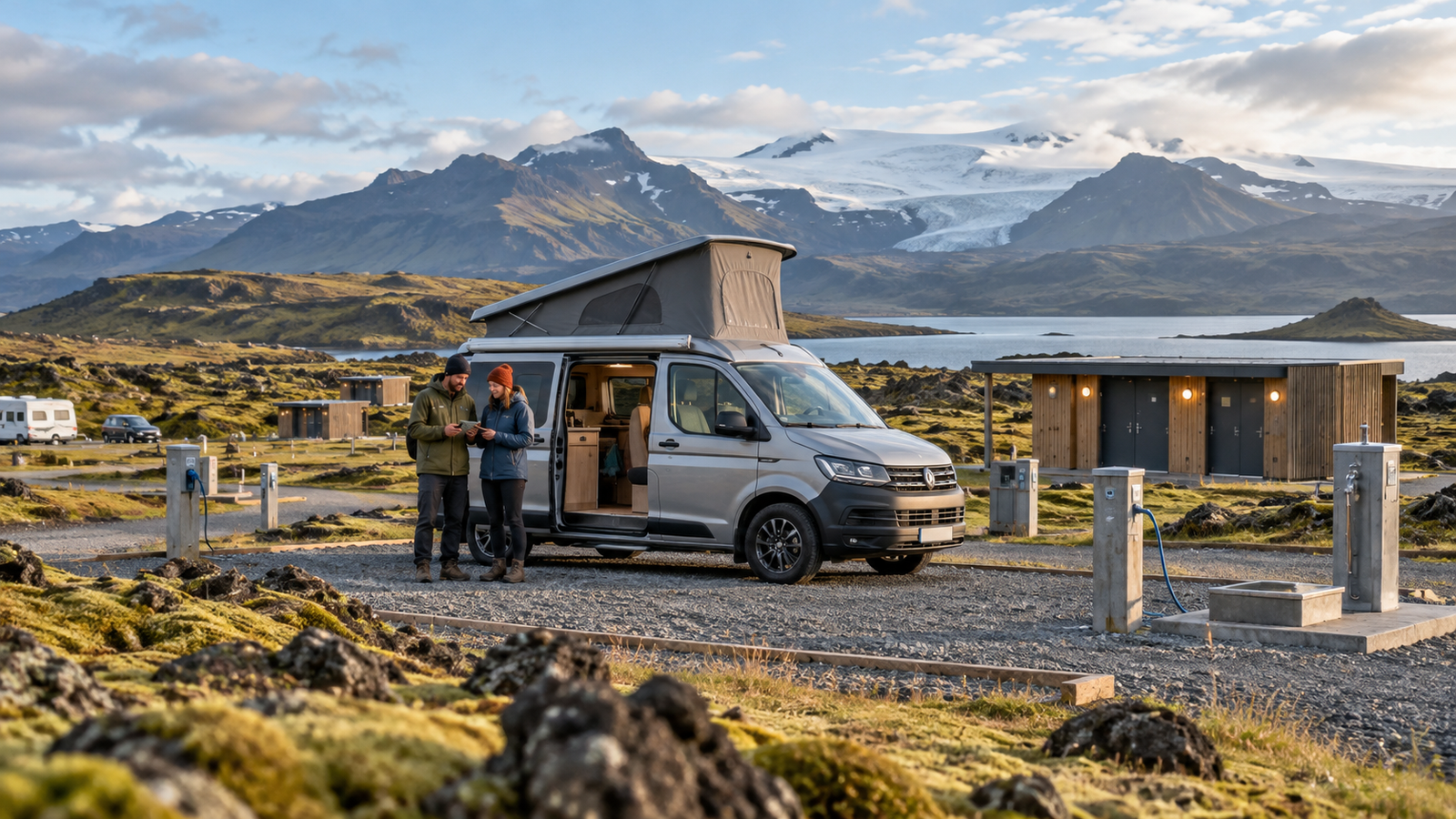
Camping in Iceland by campervan is easiest when each overnight stop is planned as a service stop, not just a picturesque place to park. The practical decision is where you can legally stay overnight and obtain toilets, water, electricity and waste services when you need them—without adding an unsafe late-evening detour.
Use a designated campsite that accepts your vehicle, or obtain any legally required landowner/rightsholder permission and comply with additional local and protected-area rules. Iceland’s more permissive rules for some traditional tents do not automatically apply to campervans. Check the actual campsite’s season, services, booking model and arrival instructions before putting it on an itinerary.
Campervan overnight rules: do not confuse vehicle camping with tent camping
The Environment Agency of Iceland’s “Where Can You Camp?” guidance cites the Nature Conservation Act and says campervans, caravans and similar vehicles cannot simply overnight outside organized campsites or urban areas without landowner/rightsholder permission. Separate tent exceptions under particular circumstances should not be copied onto a vehicle. Protected locations, including parts of national parks, have further restrictions. Visit Iceland similarly directs vehicle campers to organized sites or private land with the necessary permission.
Overnight location decision: what is actually supported
| Situation | Safe planning interpretation | What to verify |
|---|---|---|
| Organized campsite accepting campervans | Preferred default for routine overnight stays | Operating dates, camper size, pitch and service availability |
| Privately owned land with consent | May be considered with explicit relevant permission, subject to other rules | Written permission and special local/protected-area restrictions |
| Roadside pull-off / tourist car park | Do not assume it is an overnight campground | Posted rules, rightsholder permission and local prohibitions |
| Remote scenic spot / protected landscape | Not a free substitute for a campsite | Specific area regulations; many locations prohibit overnight stays |
| Traditional-tent exception | Does not authorize a parked campervan overnight | Applicable legal category and site-specific rules |
The national tourism guide says most campsites primarily operate in the warmer months and can change dates with weather. The 2026 Vaglaskógur listing shows a late-May to mid-September season, while Reykjavík Eco-Campsite specifies a restricted winter camper area. Inspect the campsite’s own latest opening notice before driving there, even if an aggregator still lists it.
Facilities checklist: which services are essentials for your vehicle?
Camping facilities are not interchangeable. A compact camper with a portable cooking kit may depend on campground toilets and a kitchen more than a self-contained motorhome. If you rent an electric camper, the phrase “electricity available” does not automatically establish compatible charging for the drive battery; shore power for a camper pitch is a different facility from a dedicated EV charging point.
Match campground facilities to the camper you are booking
| Service to verify | Why it matters | What to ask before arrival |
|---|---|---|
| Toilets / shower opening | Restrooms may have restricted access or seasonal service | Are heated toilets/showers operating on this date? |
| Freshwater and grey/black waste | Do not dispose waste in ordinary public toilets or outdoors | Is there an approved fill/disposal point on-site or nearby? |
| 16A hookup / adapter | Optional pitch power may have compatibility or added fees | Exact connector, power limit, pitch availability and fee |
| Waste and recycling | Food scraps and rubbish must be contained and properly disposed | Where are bins and sorting points? |
| Arrival / reservations | Some sites operate gated access or special check-in procedures | Book-ahead rules, access code and cutoff time |
For a specific warning: Reykjavík Eco-Campsite’s FAQ tells guests to take wastewater to the Klettagarðar 14 station rather than emptying it in the campsite’s public toilets. Its site currently notes construction around water/waste upgrades. Confirm the disposal station and its availability before setting out; do not assume a campsite has a dump station merely because it welcomes campervans.
What campsite charges look like in 2026
There is no universal camper pitch price. Visit Iceland describes many campgrounds charging roughly 2,000–3,500 ISK per person per night, often with extra charges for showers, laundry and electricity. But the Reykjavík Eco-Campsite’s 2026 operator tariff instead uses an example pitch-with-one-adult structure: 3,735 ISK without electricity or 5,715 ISK with electricity, plus 3,150 ISK per additional adult and a published 400 ISK lodging tax per unit per night at its online-discount rate. Quoted fees are site-specific and may change.
This is why a campground comparison must define its denominator: one adult per night is not the same as one vehicle/pitch per night, and the first price may exclude a second traveler or electricity. If a campsite offers a seasonal card, read which locations and services it covers rather than assuming the pass eliminates local taxes or electricity charges.
Who takes responsibility when you reserve through Parka?
Some campsites can be researched or reserved via Parka. Its camping terms describe Parka as a booking intermediary, while the specific campsite operator controls opening periods, site service, pitch availability, price, refund conditions and the actual stay. If a paid pitch cannot be used or the posted facility is missing, retain the booking email and contact the operator about service issues; Parka’s stated role is not identical to that of the campground owner. Neither a listing nor a successful payment substitutes for checking arrival access and conditions.
- First-choice site: confirm it is open, vehicle-eligible and has the services needed that evening.
- Backup site: identify another verified open option without promising any driving time or space.
- Weather stop: keep an alternative in the current town rather than drive toward a distant, unconfirmed pitch during an alert.
- Daily exit check: before departure, inspect road conditions via IRCA/1777 and any destination restrictions.
Common mistakes—and when not to choose a camper
- “The landscape is empty, so sleeping here must be fine.” That is not the legal test; use the official camper overnight rules.
- “This campsite listed showers last summer.” Verify the exact season and whether facilities operate on arrival day.
- “Electricity included” can mean a limited pitch hookup, not access to an electric-vehicle charger.
- “Booked online means refund any time.” The Reykjavík operator FAQ says its reservations are non-refundable; other sites may have different terms.
- “Camping is always cheaper.” Compare vehicle hire, pitch prices, all guests, optional electricity and waste-service logistics with lodging alternatives on the same dates.
A car plus guesthouse or hotel is often the better fit if your group needs predictable private bathrooms, accessible facilities, a fixed arrival schedule or guaranteed year-round warmth. When a camper does fit, the freedom comes from having legal and workable overnight choices—not from being able to park anywhere.
Affiliate disclosure: This article contains a CampEasy affiliate link. BookOutdoorTrips may earn a commission from a qualifying booking. Our comparisons and cautions are editorial.
See CampEasy camper models for campsite trips
Sources inspected on 22 October 2026: Environment Agency law guidance, Business Iceland / Visit Iceland camping overview, Reykjavík Eco-Campsite operator instructions, 2026 prices, Parka intermediary terms and seasonal campground example. Campsite inventory, water facilities, rates and access can change. No complete nationwide winter-opening inventory or live pitch availability was independently verified.