
Affiliate note: Some links on this page are affiliate links. If you book through them, BookOutdoorTrips may earn a commission at no extra cost to you. This does not affect our editorial judgment. Learn more.
Quick answer
“Adventure sports covered” is not a useful buying standard. The real question is whether your exact activity, location, altitude or depth, competition status, guide/licence requirements, safety equipment, and evacuation scenario fit the policy wording.
For outdoor travelers, the best comparison is an activity-by-activity verification sheet, not the longest generic list of sports.
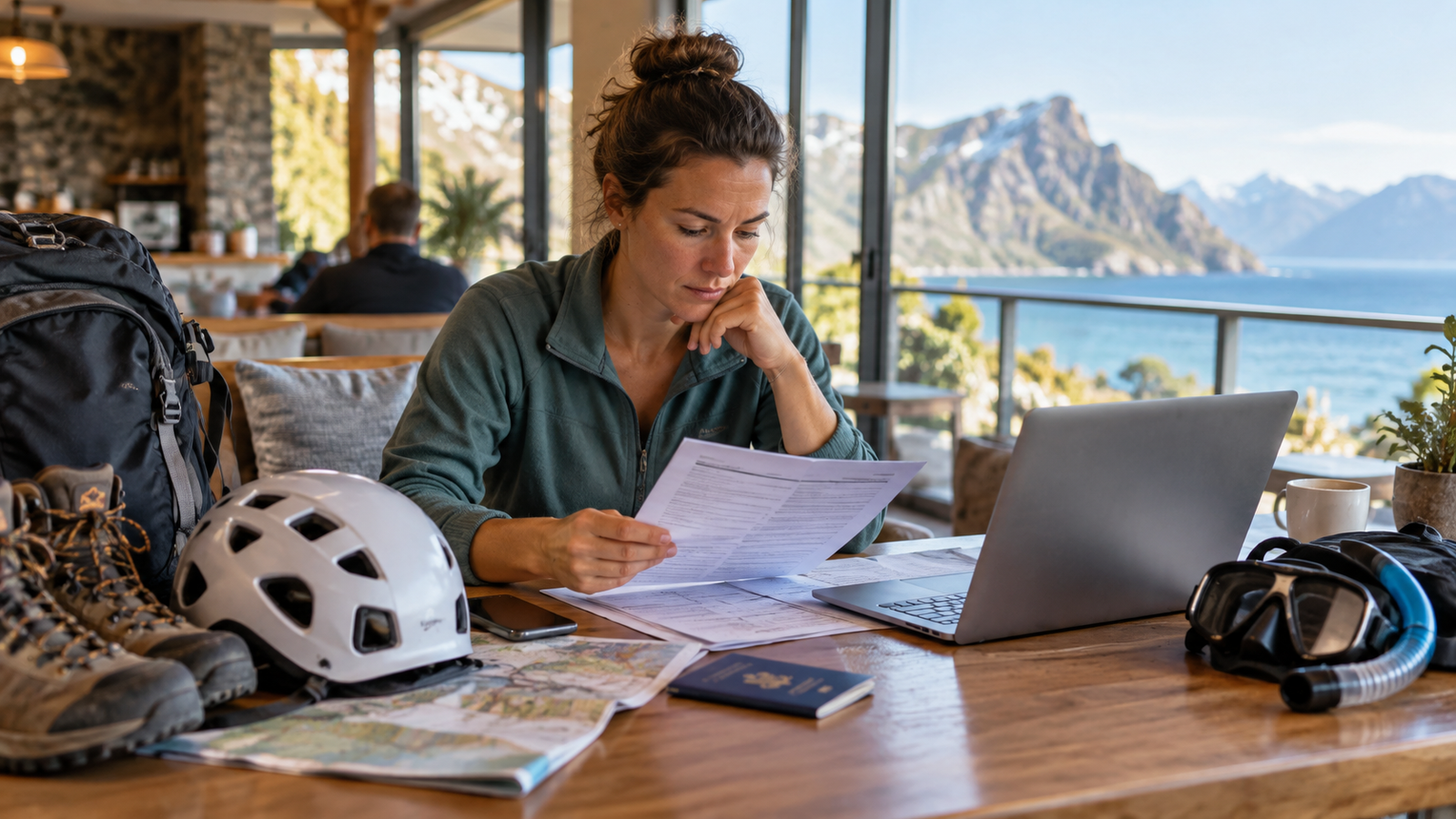
A hiking holiday, a guided dive trip, a ski season, a motorbike loop, and a mountaineering expedition can all be described as “adventure travel.” Insurers do not necessarily treat them as one risk category.
This guide shows how to check adventure-sports travel insurance without assuming that a marketing label applies to your real itinerary. It is general travel-planning information, not medical, legal, or personalized insurance advice.
The activity attributes that change the answer
When an insurer lists a sport, that is only the beginning. The same named activity can change category depending on how and where you do it.
Altitude or depth
A low-elevation hike is not the same risk as high-altitude trekking. Recreational snorkeling is not the same as a deep or technical dive. Look for thresholds and definitions.
Recreational vs competition
A leisure activity can be treated differently from racing, timed events, professional participation, or organized competition.
Guided vs independent
Some activities can depend on certifications, licensed guides, approved operators, or compliance with local rules.
Medical treatment vs rescue
A policy may pay eligible medical costs without paying every search-and-rescue or extraction expense. These benefits must be checked separately.
The safest approach is to write down the real version of the activity before reading the policy. “Skiing” is too vague. “Resort skiing on marked pistes, no racing, no backcountry, using standard safety equipment” is a much more useful description to compare against the terms.
Use an activity-verification matrix
| Activity | Details to verify | Common misunderstanding to avoid |
|---|---|---|
| Hiking / trekking | Altitude, trail type, remoteness, guide requirement, rescue access | Assuming every hike is treated the same because walking is generally allowed |
| Climbing / mountaineering | Technical grade, ropes/equipment, altitude, guided status, rescue | Confusing ordinary hiking with technical climbing |
| Skiing / snowboarding | Piste vs off-piste, competition, backcountry, avalanche/rescue rules | Assuming “skiing” automatically includes every terrain type |
| Scuba diving | Certification, depth, technical diving, guide/operator rules | Assuming recreational depth limits do not matter |
| Cycling | Touring vs racing, downhill/enduro, organized events, helmet rules | Assuming leisure cycling and competition are equivalent |
| Motorbike / scooter | Valid licence, local legality, engine/class restrictions, helmet/safety gear, alcohol | Assuming a rental shop handing you a bike proves insurance eligibility |
| Paddling / water sports | Open water, whitewater grade, offshore distance, guide/equipment rules | Assuming “water sports” is one universal category |
Ask for written confirmation when the wording is ambiguous
If the policy definition does not clearly map to your exact activity, contact the insurer before the trip and keep the response with your policy records. A screenshot of a marketing page is weaker than a current policy clause or written clarification tied to your scenario.
Search and rescue is not the same as medical evacuation
This is one of the most important distinctions for outdoor travelers.
- Search and rescue can involve locating and extracting you from a remote place.
- Medical evacuation generally concerns medically necessary transport to an appropriate facility under the policy’s definition.
- Repatriation can refer to transport back to a home country or another location in specified circumstances.
A helicopter may appear in all three scenarios, but that does not make the benefits interchangeable. A policy can define, limit, authorize, or exclude them differently. If your route includes remote mountains, islands, desert, open water, or areas with expensive private rescue services, check the actual rescue and evacuation language before departure.
Do not plan a remote trip around a headline evacuation limit alone
First ask what event triggers the benefit, who must approve the transport, which provider can arrange it, and whether search/rescue is a separate benefit. A large medical-evacuation number does not automatically pay every extraction cost.
Motorbikes and scooters: four checks before you ride
Motorbike travel deserves its own verification because legality, licensing, equipment, and intoxication conditions can interact.
- Licence: Confirm you hold the licence required for that vehicle class and jurisdiction.
- Local legality: Confirm any permit or international-driving-document requirement for the destination.
- Safety equipment: Follow the policy and local rules for helmets and protective equipment.
- Alcohol/drugs: Intoxication exclusions can defeat otherwise relevant coverage.
A rental company agreeing to rent you a scooter does not prove that your travel policy will treat you as properly licensed. Those are separate contracts and separate decisions.
Your body and your gear are different insurance problems
Travel medical coverage, rescue/evacuation, and equipment loss should be reviewed separately. A plan that is acceptable for a broken ankle may still have low per-item baggage limits for a camera, dive computer, skis, bike components, climbing equipment, or other expensive gear.
For any valuable equipment, check:
- per-item and total baggage limits;
- whether sports equipment is treated differently;
- theft evidence and police-report requirements;
- unattended-property exclusions;
- airline or carrier responsibility;
- depreciation or proof-of-purchase rules.
If your gear value is far above the policy’s baggage limits, compare specialist equipment insurance rather than assuming the travel policy will make you whole.
How SafetyWing fits this activity check
SafetyWing’s current Nomad Insurance Essential public page describes leisure-sport coverage and also describes conditional motor-accident coverage requiring licensing, appropriate safety equipment, and no intoxication. That is useful as a starting point, but it is not a substitute for checking your exact activity in the current terms.
The same public page displayed a $100,000 lifetime emergency-evacuation limit on September 29, 2026. That number should be read together with the policy definition. Do not treat “emergency evacuation” as a universal synonym for mountain rescue, search and rescue, roadside extraction, or repatriation.
For a trip built around outdoor sports, SafetyWing should therefore be evaluated with the same activity matrix as any other provider: exact activity, limits, licensing, competition, equipment, geography, and rescue/evacuation definitions.
Affiliate disclosure: If you use the SafetyWing link below, BookOutdoorTrips may earn a commission at no extra cost to you. Use the link only after you have mapped your actual activities against the current policy wording.
Planning hiking, diving, skiing, cycling, or motorbike travel? Check SafetyWing’s current activity and eligibility terms for your exact itinerary rather than relying on a generic “adventure” label.
What evidence to keep before and during the trip
Outdoor claims can involve more than a medical receipt. Build a document trail that can show what happened, where, and under what conditions.
- Policy and certificate for the correct plan version.
- Written activity clarification when wording was ambiguous.
- Licence/certification documents for diving, driving, or other regulated activities.
- Guide/operator booking and itinerary where relevant.
- Receipts for equipment and rentals.
- Incident chronology, location, photos, witness or guide details where appropriate.
- Medical records and itemized invoices.
- Police, rescue, mountain-service, coast-guard, or carrier reports where applicable.
- Pre-approval or assistance-case references.
The goal is not to predict whether a claim will succeed. It is to avoid a preventable evidence gap when the policy asks you to prove eligibility, licensing, loss, treatment, or the circumstances of an incident.
Pre-purchase activity checklist
- Name the activity precisely: not “skiing,” but the terrain and style you actually plan.
- Check altitude/depth: record the maximum expected range.
- Check competition/pro status: leisure, race, event, training, or professional work.
- Check guide/certification: any required operator, licence, certification, or permit.
- Check safety conditions: helmet, protective equipment, alcohol/drug exclusions.
- Separate benefits: medical treatment, search/rescue, evacuation, repatriation, and gear.
- Check geography: remote area, offshore route, sanctioned/restricted destination, or US treatment.
- Check pre-approval: know when the assistance team must be contacted.
- Keep proof: policy, clarifications, licences, receipts, and incident records.
Primary source used for the SafetyWing examples: SafetyWing Nomad Insurance and current policy/FAQ material identified in the research handoff. Checked September 29, 2026. Activity rules must be rechecked after any policy or covered-sports update.