
Affiliate note: Some links on this page are affiliate links. If you book through them, BookOutdoorTrips may earn a commission at no extra cost to you. This does not affect our editorial judgment. Learn more.
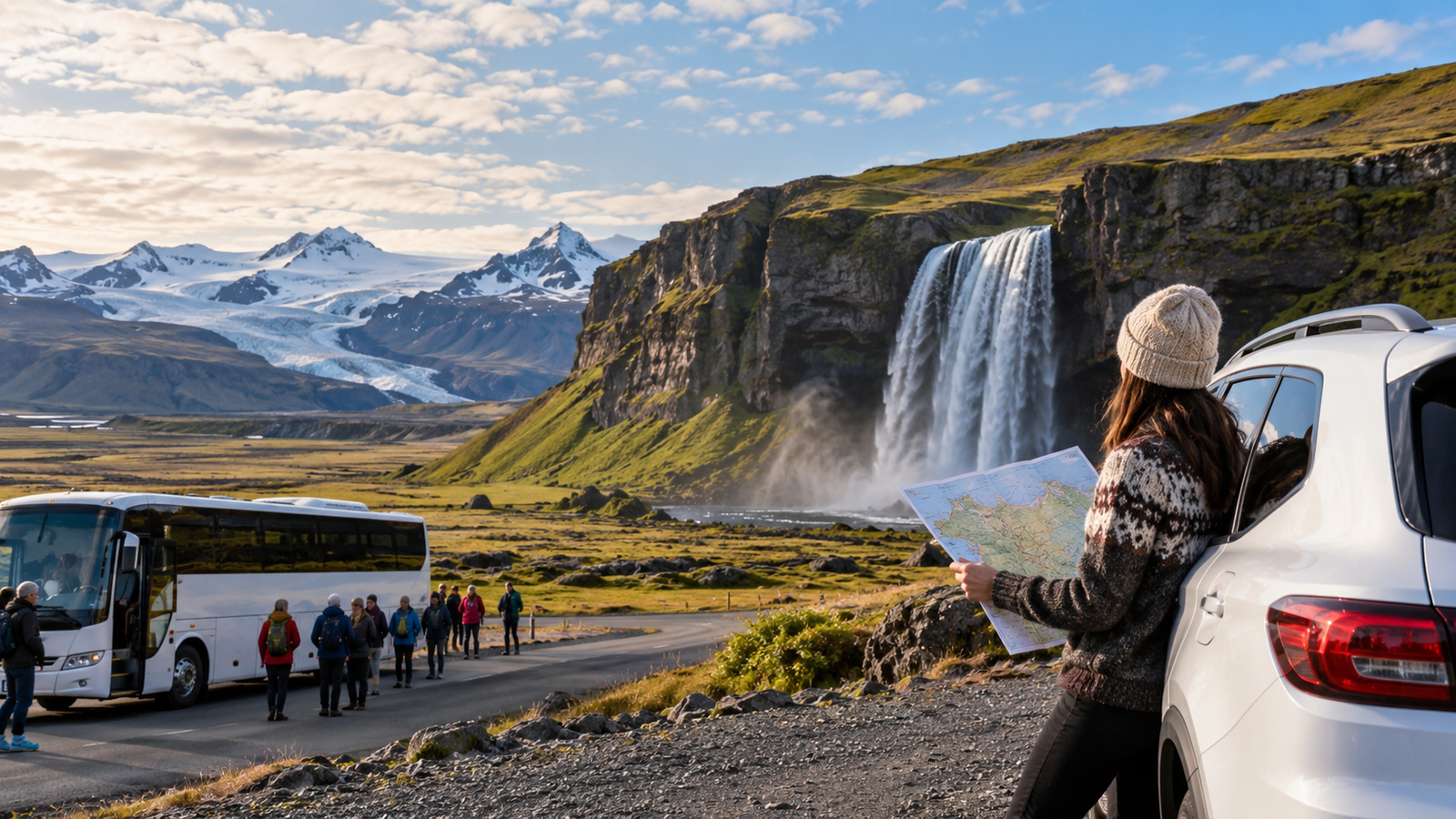
Iceland’s Ring Road can be experienced as a guided multi-day tour, an organized self-drive package or a completely independent road trip. The scenery may overlap, but the travel experience is very different.
The most important choice is not which version has the longest attraction list. It is whether you want to spend the trip driving and managing the route yourself—or hand much of that responsibility to a guide and operator.
Quick answer
Choose a guided Ring Road tour if you would rather spend your energy sightseeing than monitoring roads, navigating and driving between overnight stops. Choose self-drive if stopping when you want and controlling your own pace are central to the trip.
For either format, avoid choosing the shortest itinerary simply because it reaches the same headline attractions. The more tightly you compress the loop, the more sensitive the trip becomes to long driving days, weather disruption and unscheduled stops.
Guided Ring Road tour versus self-drive
| Decision factor | Guided tour | Self-drive |
|---|---|---|
| Driving responsibility | Handled by the tour | You are responsible |
| Navigation | Handled for you | You manage the route |
| Freedom to stop | Limited by the group itinerary | Much greater |
| Weather decisions | Operator manages route operations | You must monitor conditions and adjust |
| Daily timing | Structured | More flexible, within booked accommodation and activities |
| Social experience | Travel with a group | Private to your own party |
| Driving fatigue | Low for the traveler | Can become a major part of the trip |
| Spontaneous detours | Usually limited | One of the main benefits |
The real Ring Road question: how much driving do you want on your holiday?
Route 1 circles Iceland, linking many of the country’s major regions. That makes the Ring Road look simple on a map. But a loop trip is not just the distance between Reykjavík and a list of attractions.
Every sightseeing stop adds time. So do meals, fuel, charging, roadworks, photography stops, weather, check-in and the simple reality that you may want to spend longer somewhere than expected.
That means the correct trip length depends on more than the number of kilometers.
Compressed trip
More of each day is committed to moving forward. Delays and long stops have a larger effect on the itinerary.
Moderate pace
More room exists for sightseeing, meals and ordinary travel friction without every delay becoming stressful.
Slower loop
Better suited to travelers who want additional regional stops, photography or activities rather than treating the Ring Road as a checklist.
Guided format
Useful when you want to cover a broad route but do not want the driving workload yourself.
Guide to Iceland’s current Ring Road inventory illustrates this variation: its marketplace lists both roughly week-long Ring Road products and longer self-drive options. Their existence should not be interpreted as proof that one duration fits every traveler. Use them as evidence that multiple pacing models exist.
Guided Ring Road tours: what you gain and what you give up
A guided multi-day tour removes several difficult planning jobs at once. Transportation, much of the route sequencing and the core schedule are managed for you.
This format is strongest for travelers who:
- do not want to drive long distances;
- are nervous about changing weather or road conditions;
- prefer to know where they are going each day;
- do not mind traveling on an operator’s schedule;
- want a guide to provide context during the journey.
The main cost is flexibility. You cannot assume the vehicle will stop every time a landscape catches your attention. Your meal times, departure times and sightseeing windows are shaped by the group’s schedule.
Before booking a guided tour: read the actual day-by-day itinerary. Count one-night stops, check how much ground is covered each day and identify which activities are included versus optional.
Self-drive: freedom comes with operational responsibility
The self-drive version is appealing because Iceland rewards spontaneous stopping. A waterfall, viewpoint or coastline that seems minor on a map may become one of the best parts of your day.
But self-driving means accepting responsibility for several things that disappear into the background on a guided trip:
- road-condition checks;
- weather monitoring;
- fuel or charging;
- navigation;
- rental-car conditions;
- arrival times for activities;
- hotel check-in timing;
- deciding when conditions justify changing the plan.
Iceland’s official Umferdin service publishes current traffic and road-condition information. The Icelandic Meteorological Office publishes weather forecasts and alerts. Both belong in the daily routine of a serious self-drive itinerary.
Season changes the decision
The same Ring Road itinerary can feel very different in different seasons.
| Condition | Effect on self-drive planning | Effect on guided-tour planning |
|---|---|---|
| Longer usable daylight | More flexibility in how sightseeing is distributed | Can support fuller sightseeing days |
| Snow, ice or poor visibility | Raises the skill and judgment required from the driver | Operational decisions are primarily handled by the operator |
| Strong winds | Can materially affect driving comfort and safety | May cause operator changes or disruption |
| Road closure | You need to reroute, wait or alter the itinerary | The operator determines how the tour responds |
| Highland side trip | Requires a separate vehicle/road-access check | Depends on the booked excursion and operator |
Do not confuse the Ring Road itself with every side trip that branches from it. Some detours can introduce very different road conditions and vehicle requirements.
SafeTravel’s Highland guidance, for example, warns that F-road driving can involve rough terrain and unbridged rivers and that not every 4WD is suitable for every route.
A self-drive package can split the difference
There is a third option between a guided tour and pure DIY: a pre-arranged self-drive package.
Current Guide to Iceland self-drive packages commonly combine a rental vehicle, pre-arranged accommodation and an itinerary framework, with activity options varying by product. You remain the driver, so you retain much of the independence of a road trip while avoiding some of the booking work.
This can be useful if your problem is not driving—it is coordinating the trip.
It is less useful if your idea of freedom is deciding each morning where to sleep that night, because pre-booked accommodation still places structure around the route.
Commercial disclosure: We may earn a commission from qualifying bookings made through links on this page.
Compare Ring Road tour formats
Once you know whether you want guided travel or self-driving, compare the current itineraries by pace, accommodation pattern, included activities and cancellation conditions—not simply by the number of attractions listed.
Browse current Iceland Ring Road options on Guide to Iceland
How to audit the pace before you book
A good Ring Road itinerary should survive more than a map calculation.
For each day, ask:
- Where do I wake up?
- Where do I sleep?
- How much driving sits between them?
- How many meaningful stops are planned?
- Is a timed tour or activity included?
- How much time remains for meals and unplanned stops?
- What happens if weather delays the route?
- Can one missed stop be dropped without breaking the rest of the itinerary?
If a day works only when every transfer runs perfectly and every stop takes the minimum possible time, it is fragile.
Avoid treating modeled driving time as guaranteed travel time. Iceland’s weather and road conditions can change, and sightseeing itself makes real travel days longer than point-to-point navigation suggests.
Who should choose a guided Ring Road tour?
The guided format is particularly sensible if you:
- want to see multiple Iceland regions but dislike long-distance driving;
- are visiting in conditions you do not feel comfortable driving in;
- prefer structured days;
- want the route logistics handled by someone else;
- are comfortable trading spontaneity for simplicity.
Who should choose self-drive?
Self-drive is a stronger fit if you:
- enjoy road trips rather than merely tolerating the driving;
- want freedom to stop for landscapes and photography;
- are comfortable monitoring weather and road information;
- want more privacy than a group tour provides;
- are willing to change the plan when conditions require it.
Ring Road booking checklist
- Choose guided, packaged self-drive or DIY before comparing products.
- Audit the itinerary day by day.
- Check how often accommodation changes.
- Identify the longest driving days.
- Check which activities have fixed meeting times.
- Verify what the package includes.
- Check luggage restrictions on guided tours.
- Check the rental vehicle and insurance on self-drive trips.
- Check cancellation and weather-disruption policies.
- Use Umferdin for current road conditions.
- Use the Icelandic Meteorological Office for weather and alerts.
- Build enough flexibility to drop a stop or alter a day when necessary.
The Ring Road decision ultimately comes down to what you want the journey itself to feel like. A guided tour turns transportation into a managed service. Self-drive turns the road into part of the experience. Neither format is inherently superior—the right one depends on how much flexibility, driving responsibility and itinerary control you actually want.
Last reviewed: October 1, 2026. Road conditions, weather, tour inventory, accommodation and individual itinerary details can change.