
Affiliate note: Some links on this page are affiliate links. If you book through them, BookOutdoorTrips may earn a commission at no extra cost to you. This does not affect our editorial judgment. Learn more.
“Glacier tour in Iceland” can describe very different experiences. A short introductory glacier walk, a longer hike, an ice-climbing trip and an ice-cave excursion may all appear beside each other in search results, yet require different fitness, equipment, transport and seasonal conditions.
The safest way to choose is not to start with the most dramatic photos. Start with eligibility, meeting point, physical difficulty and current conditions.
Quick answer
Choose an introductory glacier hike if you want to experience the ice with a guide without turning the activity into the hardest part of your trip. Choose a longer or more technical hike if you are comfortable with greater physical effort. Choose an ice-cave experience for the cave environment itself, but pay particular attention to season and current access conditions.
Do not assume that all glacier tours have the same minimum age, fitness requirements, equipment or departure point. Current listings vary materially on all four.
First decide what kind of glacier experience you actually want
| Experience | Typical decision | What matters most |
|---|---|---|
| Introductory glacier hike | First glacier experience | Minimum age, footwear, walking ability, meeting point and tour length |
| Longer glacier hike | More time on the ice | Fitness, duration, terrain and weather exposure |
| Ice climbing | More technical activity | Minimum age, physical demand, harness/technical gear and guide requirements |
| Ice cave tour | See seasonal ice formations | Current cave access, season, transport and conditions |
| Glacier activity from Reykjavík | Combine glacier experience with a longer sightseeing day | Total transport time, itinerary length and what happens at the glacier |
| Meet-on-location tour | Best for travelers already in South Iceland | Exact meeting point, arrival time and your own transport |
Minimum age is a product rule, not an Iceland-wide number
This is one of the most important differences hidden inside glacier listings.
Current Guide to Iceland products illustrate why a universal age rule would be misleading. One family-oriented Skaftafell glacier hike currently lists a minimum age of 8, while other longer or more demanding glacier hikes currently list a minimum age of 14. Ice-climbing and other technical activities can apply different requirements again.
The correct question is therefore not “How old do you have to be to hike a glacier in Iceland?” It is “What is the minimum age for this exact tour?”
Do not book an activity for a family based on the age requirement of a different glacier tour. Check the specific product page immediately before booking.
Difficulty labels do not tell the whole story
A tour described as “easy” still involves an outdoor environment with ice, uneven terrain, changing weather and specialized equipment.
Likewise, a “moderate” glacier hike may differ significantly from another moderate activity in duration, incline and time spent on the glacier.
Before choosing by difficulty, check:
- total tour duration;
- estimated time actually spent hiking;
- minimum age;
- fitness expectations;
- whether walking on uneven ice is involved;
- whether ice climbing or ropes are part of the activity;
- what footwear is required;
- whether the operator can refuse participation if equipment is unsuitable.
Travelers with mobility limitations, recent injuries or uncertainty about their ability to complete the activity should use the operator’s stated requirements rather than relying on a generic description such as “beginner friendly.”
Where the tour starts can be as important as the activity
Many glacier tours in the Skaftafell and Vatnajökull area are meet-on-location experiences. That means you are responsible for reaching the meeting point yourself.
Current Guide to Iceland Skaftafell listings show departures from different local bases around the Skaftafell area rather than from one universal glacier-tour terminal.
Other products incorporate long-distance transportation as part of a South Coast day tour.
Already staying in South Iceland?
A meet-on-location glacier hike can avoid adding unnecessary Reykjavík transfer time.
Based in Reykjavík without a car?
Compare tours that include transportation rather than assuming a Skaftafell listing provides pickup from the capital.
Driving the Ring Road?
A local glacier tour may fit naturally into the route, but build margin around the required check-in time.
Tight itinerary?
Check the full door-to-door commitment, not just the advertised time on the glacier.
What equipment is normally supplied?
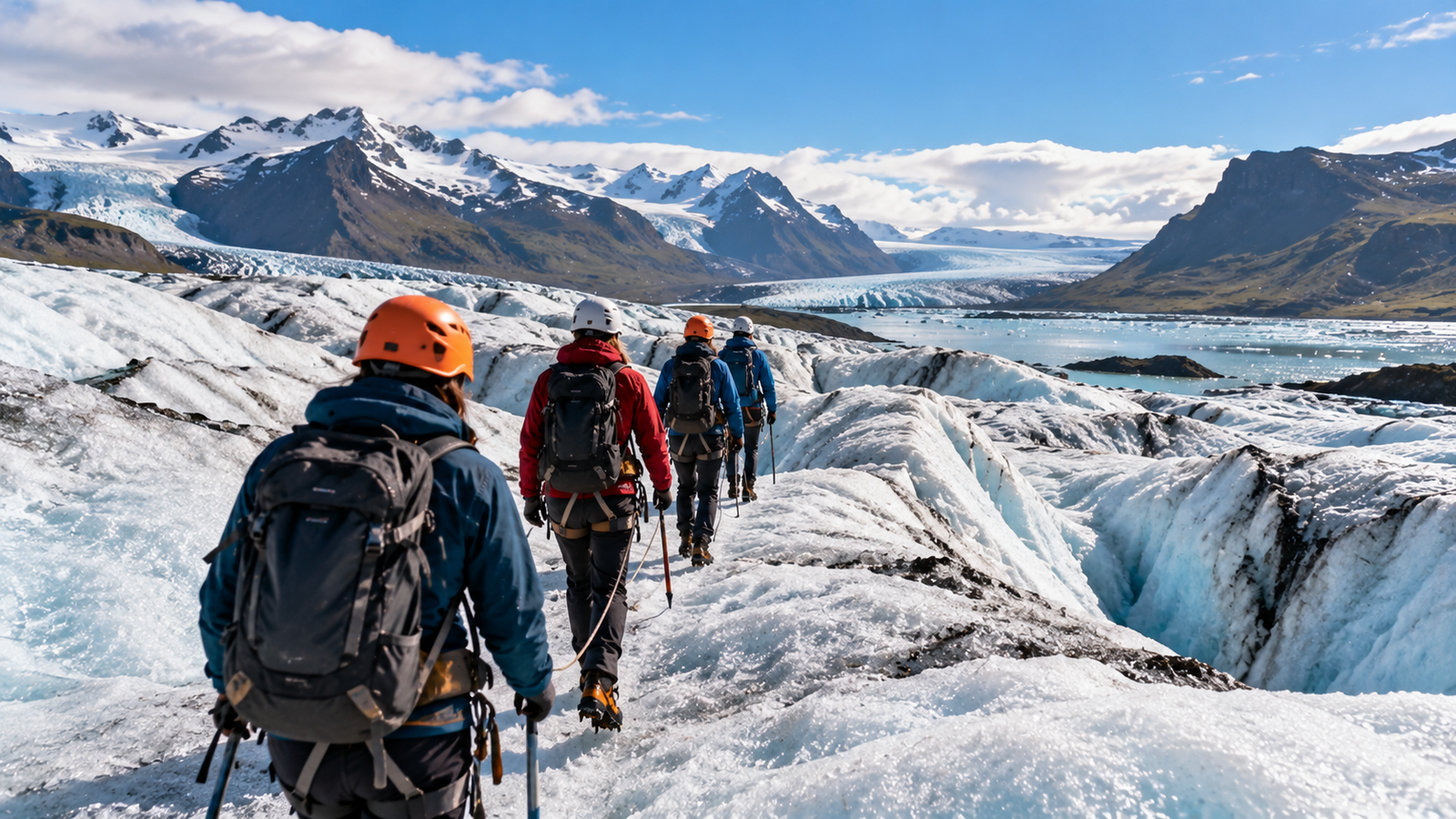
Glacier hiking requires specialized equipment. Current Guide to Iceland glacier-hike listings commonly describe gear such as crampons, helmets, harnesses and ice axes as included, but the exact kit differs by activity and operator.
Your own clothing still matters.
- Check whether hiking boots are required or rentable.
- Bring warm layers appropriate to the forecast.
- Use weather-resistant outer clothing when required.
- Check whether gloves and a hat are recommended.
- Do not assume ordinary casual footwear will be accepted.
- Check which technical equipment is supplied rather than purchasing it unnecessarily.
If an operator specifies footwear or clothing requirements, treat them as participation requirements rather than optional packing suggestions.
Glacier hiking and ice caves should not be treated as the same product
A glacier hike is primarily an activity on the glacier surface. An ice-cave tour depends much more heavily on the existence and safe accessibility of a particular ice formation.
Ice conditions change naturally. Access can therefore change even when an Iceland trip itself is operating normally.
For an ice-cave booking: verify the exact cave or glacier area, season, transportation method, current access conditions and what alternative the operator provides if the intended cave cannot be used.
Vatnajökull National Park has previously restricted access to unsafe ice formations and applies professional requirements to commercial glacier and ice-cave activities. That history is a useful reminder that access should follow current professional assessments rather than tourist expectations.
Weather cancellation is not the same as light rain
A glacier tour does not necessarily stop because the weather is imperfect. Operators routinely run in ordinary Icelandic conditions when they consider the activity safe.
More serious weather or unsafe glacier conditions can cause a cancellation or itinerary change.
Guide to Iceland’s current glacier-tour guidance states that many glacier walks can operate in light rain, while worse weather may result in cancellation and refund or rescheduling according to the relevant booking conditions.
Do not plan an international flight or another immovable activity immediately after a glacier tour. Weather-dependent outdoor activities deserve schedule margin.
Longer does not automatically mean better
A longer glacier experience can provide more time to explore glacier features and move farther from the access point. It can also demand more energy and consume more of the day.
Consider what you actually want:
| If your priority is… | Start by comparing… |
|---|---|
| A first experience on glacier ice | Shorter introductory hikes |
| More time exploring glacier terrain | Longer glacier hikes |
| A technical challenge | Ice climbing or advanced glacier activities |
| A visually distinctive cave environment | Current ice-cave tours |
| Combining glacier activity with sightseeing | South Coast packages that include transport |
Who should reconsider a glacier tour?
A glacier activity may be a poor fit if:
- you do not meet the specific minimum age;
- you cannot meet the operator’s mobility or fitness requirements;
- you cannot wear the required footwear or safety equipment;
- your itinerary does not allow enough time to reach the meeting point;
- you are expecting an ice cave outside its viable conditions or season;
- you need an activity that cannot tolerate weather-related changes.
For personal medical questions, use the operator’s participation requirements and obtain appropriate professional advice rather than relying on a general travel article.
Commercial disclosure: We may earn a commission from qualifying bookings made through links on this page.
Compare glacier tours after checking eligibility
Once you know the activity type, minimum age, difficulty and meeting-point requirements that fit your trip, compare current glacier experiences by exact inclusions and policies.
Glacier-tour booking checklist
- Choose glacier hike, ice cave, ice climbing or another glacier activity.
- Check the exact minimum age.
- Check fitness and mobility requirements.
- Confirm the meeting point.
- Confirm whether Reykjavík transportation is included.
- Check required arrival time.
- Check which glacier equipment is provided.
- Check footwear and clothing requirements.
- Verify the current operating season.
- Read the weather cancellation and rescheduling policy.
- For ice caves, verify current access rather than relying on old photos or reviews.
- Leave enough itinerary flexibility for weather-dependent changes.
The most suitable Iceland glacier tour is not necessarily the longest or most dramatic option. It is the activity whose difficulty, eligibility, transport and conditions match the traveler standing on the ice.
Last reviewed: October 1, 2026. Glacier access, minimum ages, equipment requirements, meeting points, seasonal conditions and tour availability can change.
Primary sources: Guide to Iceland Glacier Hiking Tours; current individual Guide to Iceland glacier product pages; Vatnajökull National Park. Always use the specific operator listing for eligibility and current safety requirements.