
Affiliate note: Some links on this page are affiliate links. If you book through them, BookOutdoorTrips may earn a commission at no extra cost to you. This does not affect our editorial judgment. Learn more.
Quick decision: To travel from Bali to the Gili Islands, choose the island and actual arrival point first, then compare departure ports by the whole trip from your Bali accommodation. Padang Bai often means a shorter sea crossing but more road travel from parts of south Bali; Serangan can reduce the road leg for south-Bali stays. Neither port wins automatically. Buy a ticket only after confirming the named carrier, island stop, check-in deadline, baggage rules, extra levies and a realistic return buffer before an international flight.
Gili Trawangan, Gili Air and Gili Meno lie off Lombok, not beside Bali’s southern resorts. The Indonesian tourism authority’s Gili Trawangan guide identifies fast-boat connections from Bali and boat connections via Bangsal in North Lombok. That gives travelers two genuinely different route families: cross from Bali on a fast boat, or approach from Lombok and make a shorter final transfer. Your choice matters more than a headline crossing time if you have luggage, children or a fixed onward flight.
Choose the correct Gili arrival, not merely a ticket marked “Gili”
These destinations are not interchangeable. On MyBaliTrips’ fast-boat product page, the displayed Ostina ticket examples from Padang Bai distinguish Gili Trawangan, Gili Air and Bangsal. Bangsal is on mainland Lombok; it is not another name for Gili Meno. A fare to Bangsal may be useful when you are staying on Lombok or arranging a separate island shuttle, but it is not necessarily the endpoint for a guesthouse on Gili Air.
Gili Meno particularly needs careful reading of the ticket. The MyBaliTrips page broadly describes Gili Meno among possible destinations, while some of the visible individual Ostina examples stop at Trawangan, Air or Bangsal. Other carriers handle Meno differently: BlueWater Express states that its own services do not land at Gili Meno and suggests a local connection from Trawangan or Air; Eka Jaya’s conditions describe shuttle transfers and earlier local check-in for Meno and Air on some services. Confirm whether your exact boat lands at your island or requires a second boat, who organizes that segment, and whether its price and timing are included.
Padang Bai, Serangan or via Lombok?
| Route family | When it is a reasonable fit | The less obvious trade-off |
|---|---|---|
| Bali → Padang Bai → Gili | Often worth comparing first from central/east Bali or when shorter open-water time is important. | Road transfer from your Bali hotel and port check-in may consume more time than expected; verify the boat’s actual island stops. |
| Bali → Serangan → Gili | Often worth comparing from the south-Bali hotel areas, particularly when pickup logistics dominate the day. | Sea time and intermediate island stops may be longer; available routes and transfer inclusions vary by carrier. |
| Lombok → Bangsal/Teluk Nare → Gili | An alternative if arriving at Lombok airport, spending time on Lombok or avoiding a long Bali–Gili sea passage. | Requires a separate journey across Lombok to the boat harbor, then a local crossing and possibly a separate ticket. |
The port trade-off is supported by the BlueWater Express operator schedule guide, which recommends Serangan for south Bali and Padang Bai for central Bali. Its operator FAQ states that the Padang Bai sea leg is shorter for its routes; that is not a universal door-to-door travel-time comparison for every operator, date or hotel. The national tourism authority’s Lombok route guidance identifies Bangsal and Teluk Nare as gateways from the mainland.
Work with the schedule for the ferry you can actually book. A multi-stop itinerary from a convenient port might reach your island later than a different carrier with a less convenient road approach. Also check the return route; its intermediate stops and arrival port on Bali need not mirror the outbound journey. An accommodation pickup that starts far from your hotel can turn an apparently simple bundled ticket into an early and tiring travel day.
What a “two-hour crossing” leaves out
For one Ostina example, MyBaliTrips tells passengers to check in 60 minutes before departure at the port office and describes a roughly two-and-a-half-hour journey. The same product page says listed times and availability are for reference and must be confirmed with the manager. Neither the crossing estimate nor the displayed departure should be treated as a live promise for your specific date.
A door-to-door plan has at least six stages: hotel → Bali port → check-in/boarding → sea passage and intermediate stops → island disembarkation → accommodation. On the return, add island check-in and the Bali port-to-hotel or port-to-airport journey. If you are booking a separate hotel transfer, check whether the meeting point is your accommodation door, a shared pickup hub or the harbor itself. Keep the ticket and any return stub required by the operator; the Ostina example specifically tells travelers to retain the paper ticket for the return leg.
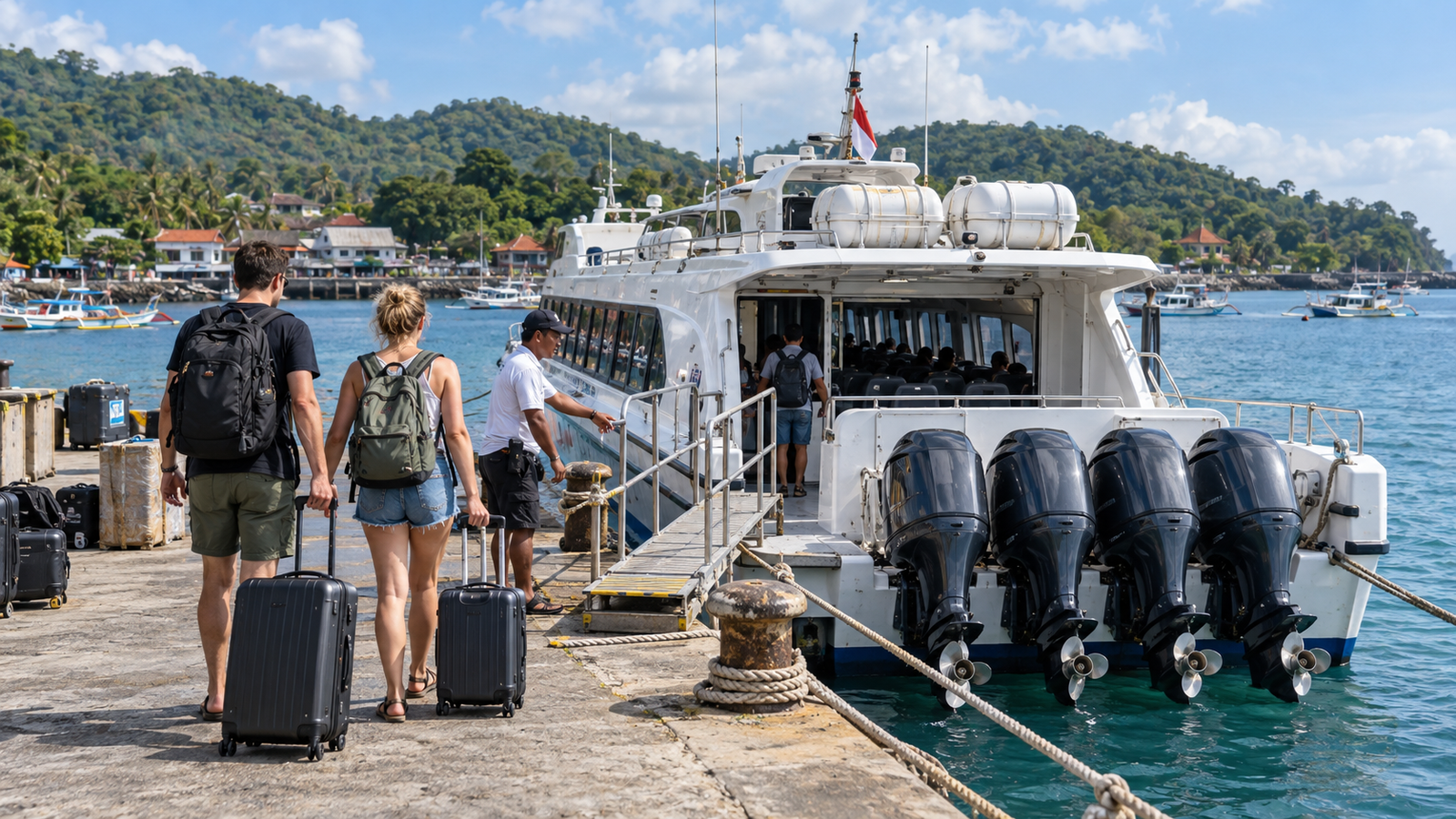
The phrase “fast boat” also does not indicate one standard vessel. Boats differ in size, enclosed seating, baggage handling, step height and access arrangements. Anyone traveling with a stroller, bulky dive bags, reduced mobility, significant back pain or severe motion sickness should contact the named boat operator with those needs. Do not infer a vessel’s safety certification, facilities or suitability from a marketplace category label or from photographs of a different boat.
Compare a full, payable trip budget—then challenge the port-tax figure
The useful comparison is boat fare in the right direction and class + Bali hotel/port transfer + any Gili or Padang Bai harbor charges + extra island transfer + excess baggage/handling + change or cancellation exposure. For a return ticket, calculate both land transfers and both sets of port/arrival charges. Travel dates, vessel, whether the fare is one-way or round-trip, and passenger type must match before you compare totals.
A notable discrepancy needs explicit confirmation. In the MyBaliTrips Ostina example checked on 14 October 2026, the “Important Information” section names a Rp 10,000 Padang Bai departure harbor tax, while the separate “Not included” section on the same page lists a Rp 30,000 Padang Bai harbor tax. Both sections also mention a separate Gili harbor charge. Because the two Padang Bai figures conflict, there is no defensible single total to quote here. Ask the booking manager, ticket issuer or port for the amount, collection point, traveler category and whether it has already been paid; retain the written reply.
That merchant example also offers an optional group transfer at an advertised Rp 60,000 per person per direction, subject to arranging it with the manager. It does not make every hotel eligible or every operator’s transfer price the same. A ticket labeled “no transfer” should be costed as exactly that. Avoid paying twice for a hotel pickup that another fare class already includes.
Whose refund and baggage rules apply when a marketplace sells the seat?
MyBaliTrips lists tickets from several carriers rather than operating every vessel named in its catalog. Its Ostina product terms describe a traveler cancellation at least 24 hours before the trip with a 10% deduction, and a full refund where the provider cannot deliver the service. That published product clause is not a general policy for every Bali–Gili carrier or date.
By contrast, Eka Jaya’s published direct-carriage terms describe different cancellation windows: more than seven days, between seven days and two days, and fewer than 48 hours before departure, with materially different refunds. Its FAQ explicitly warns that third-party agent refund conditions may differ. So a screenshot of one carrier’s website is not a promise that the merchant booking will follow the same refund rule. Ask the seller which ticket issuer receives your payment, which conditions govern each leg, and who handles refunds or schedule changes after confirmation.
For luggage, the Eka Jaya carriage terms specify two pieces totaling no more than 25 kg, but its FAQ presents a checked-bag allowance plus a separate hand-carry allowance. Even those two operator documents are not perfectly aligned. Do not infer a universal “25 kg plus carry-on” entitlement—have the actual carrier confirm the rule for the vessel and booking before checking a large bag or bringing sporting equipment. MyBaliTrips’ Ostina ticket page does not establish Eka Jaya’s allowance for an Ostina passenger.
Some operator guidance also identifies health-related cautions for pregnant passengers and travelers with certain medical or mobility issues. Such wording is operator-specific and does not establish who is legally permitted or medically fit to travel. Ask the carrier about boarding and assistance and obtain personal medical advice if your condition makes a rough-water crossing concerning; do not assume insurance protection because a boat is ticketed.
What happens when the Lombok Strait disrupts your route?
Sea conditions and harbor-master decisions can alter a crossing. Indonesia’s BMKG northern Lombok Strait marine forecast reports wind, waves and currents for the forecast period; check a fresh forecast just before departure, together with the local port and carrier advice. A forecast is planning information, not a guarantee of departure or arrival time.
The MyBaliTrips Ostina listing warns that a bad-weather crossing can involve an alternative ferry route. Eka Jaya’s carrier terms reserve the ability to cancel, delay or reschedule for weather, safety and port directions and state that onward travel and hotel losses are generally the passenger’s responsibility under its published terms. Its site recommends allowing at least a day before onward plans; the particular MyBaliTrips Gili listing advises returning from the islands no later than two days before a departure from Bali. These are separately sourced operator/merchant recommendations, not an assurance of sufficient time for every disruption.
For a flight you cannot afford to miss, a night or more on Bali before leaving Indonesia is often a better risk choice than the last available island boat. Two nights may be prudent when schedules are thin or weather uncertain, but no number of days eliminates all risk. A traveler who needs a reliable return date may prefer flying from Lombok where a feasible route and flight exist; remember that the Lombok-airport plan still needs ground transport and flight contingencies.
A practical disruption plan for ticket holders
- Before departure: save the actual ferry operator, booking agent, ticket number, Gili arrival and return departure port, plus their official contact details. Confirm the next-day operating plan directly.
- If delayed before boarding: ask whether your seat is rescheduled, substituted to another vessel, diverted through Lombok or canceled; request confirmation of revised arrival, transfer coverage and fee consequences in writing.
- If you miss an onward connection: contact the affected accommodation, driver or airline directly instead of assuming a boat operator pays the resulting expense. Keep notices and receipts for any claim you may be eligible to make under your own policy.
- If return transport is uncertain: check alternative sailings, the mainland Lombok route and actual seats before purchasing nonrefundable replacement travel; changing modes without confirmed connections may create further losses.
An Indonesia Travel overview of reaching Gili Trawangan identifies the alternate Bangsal connection and travel via Lombok. It does not establish that a late-running Bali boat can automatically be replaced by a same-day alternative. Availability, transfer access, pricing and weather restrictions must be checked on the actual day.
When to book through MyBaliTrips, and when to compare the carrier directly
A merchant that presents several ferry operators in one catalog is useful if you want to compare possible departure times and ask an intermediary to coordinate a hotel pickup. But it adds a responsibility boundary: the booking agent issues or services the order while the named carrier operates the crossing and the port authority controls safety clearance. If you already know the exact operator, its direct booking channel is a worthwhile comparison for fare conditions, luggage allowance and who handles disrupted sailings. Neither sales route is automatically cheaper, faster or safer.
Before committing, get a screenshot or written confirmation that states the operator, Bali departure port, exact Gili stop, check-in deadline, total fare and levies, luggage allowance, included pickup and the complete return route. For Gili Meno in particular, demand explicit confirmation of any onward shuttle; for a Bali airport connection, build in a weather-flexible buffer rather than hoping that the fastest advertised crossing will occur.
This article contains an affiliate link. BookOutdoorTrips may earn a commission if a booking is made through it; route comparisons and risk guidance are editorially independent.
Once your island, port and connection requirements are clear, review the available Bali–Gili ticket options on MyBaliTrips. Use the operator and final checkout details—not an undated headline fare—to choose or reject a sailing.
Research note: The specific merchant ferry listing, BlueWater and Eka Jaya operator information, Indonesia Travel guidance and BMKG marine resources were checked on 14 October 2026. Port fees, route stops, weather, luggage limits, ferry availability and booking terms may change or differ among operators; verify for your exact travel dates. The published Padang Bai levy discrepancy above remains unresolved by the merchant’s page and must be checked before payment. No firsthand voyage or live ticket availability is implied.