
Affiliate note: Some links on this page are affiliate links. If you book through them, BookOutdoorTrips may earn a commission at no extra cost to you. This does not affect our editorial judgment. Learn more.
Quick answer
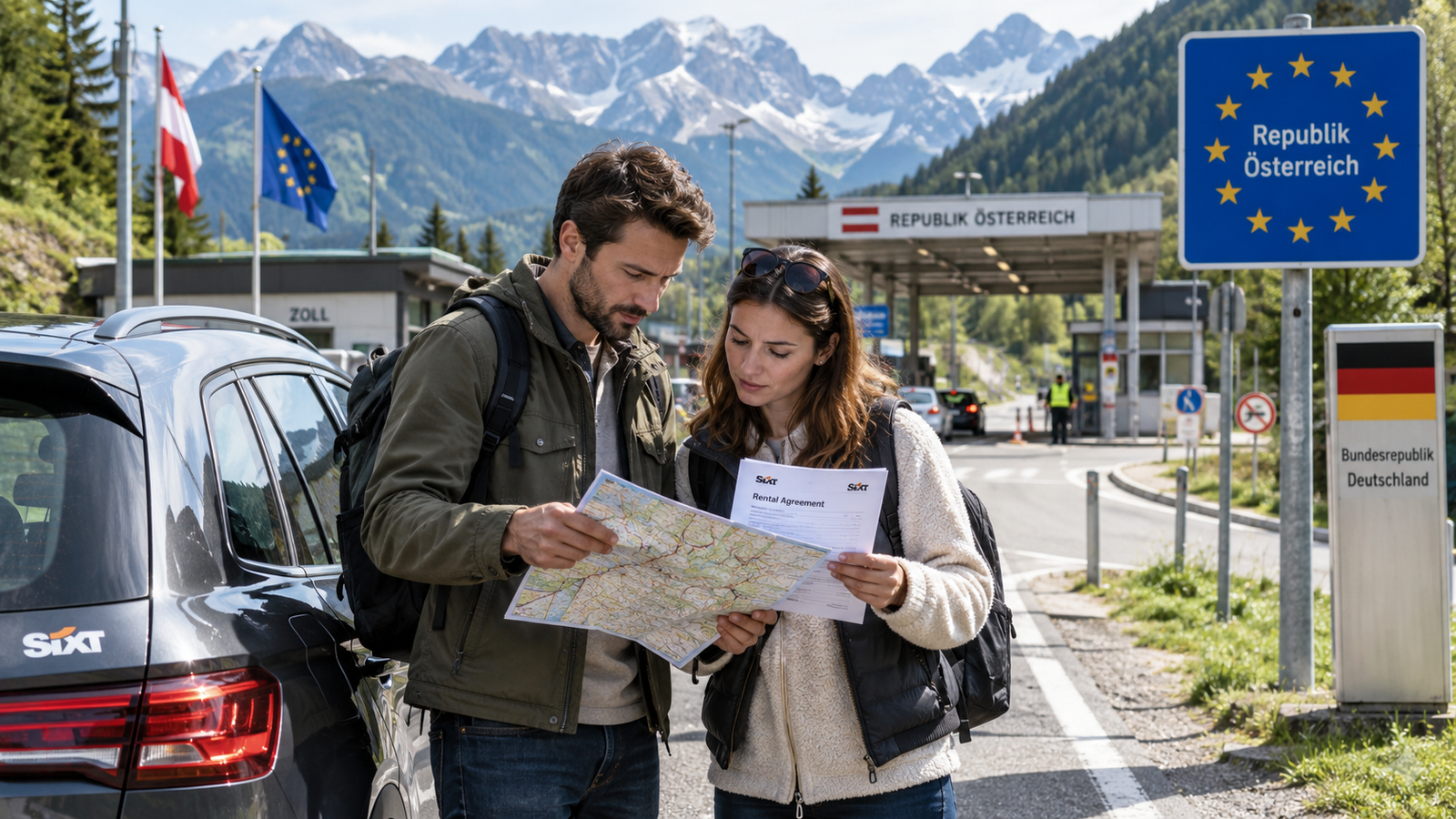
A road border being open does not mean your rental car is contractually allowed to cross it. For a cross-border rental in Europe, verify the exact supplier, pickup country, destination country or countries, vehicle class, written permission, cross-border fee, territorial insurance cover and breakdown support before you pay.
Source pack checked: September 28, 2026. Country-pair permissions, fees, route availability and supplier rules are volatile and must be confirmed for the exact booking.
Schengen, the EU and your rental contract are three different things
Travelers often see a border with no routine passport stop and assume the rental car can cross it freely. That mixes together three separate questions:
Can a traveler cross?
Immigration and border rules determine whether you personally may enter the next country.
Can this vehicle cross?
The rental supplier may restrict countries, vehicle classes, ferries, islands or specific routes even when ordinary road travel is permitted.
Does the protection still apply?
Insurance, waivers, roadside assistance or reimbursement products may have territorial limits or notification requirements.
Do not use “Schengen” as a shortcut for rental permission
Schengen rules concern border controls between participating countries. They do not override the rental supplier’s contract, vehicle restrictions, insurance territory or one-way inventory.
The cross-border route-validation test
Validate the trip as a sequence of exact countries, not as a vague plan to “drive around Europe.” A route from Country A to B to C can fail because one leg is excluded even if the others are allowed.
| Check | Question | Evidence to save |
|---|---|---|
| Supplier | Which company actually supplies the vehicle? | Booking confirmation and supplier name. |
| Country pair | Is travel from the pickup country into every planned country permitted? | Current supplier terms or written approval. |
| Vehicle class | Does the permission apply to this vehicle category? | Vehicle-class restrictions in the booking terms. |
| Fee | Is there a cross-border, administration, vignette or other route-related charge? | Checkout disclosure or supplier fee schedule. |
| Protection | Does the applicable cover remain valid in every country? | Policy wording, waiver terms or benefit guide. |
| Roadside support | Will breakdown assistance operate on the full route? | Supplier/assistance territorial terms. |
| Return plan | Must the car return to the pickup country, or is an international one-way return allowed? | Exact return-location confirmation and any one-way charge. |
Use a country-pair permission matrix — but fill it with booking-specific evidence
A useful matrix is a verification tool, not a universal list copied from the internet. Complete one row for every border your itinerary crosses.
| Route leg | Supplier permission | Vehicle restriction | Fee | Cover valid? | Evidence saved |
|---|---|---|---|---|---|
| Country A → Country B | Confirm | Confirm | Confirm | Confirm | Terms / written approval |
| Country B → Country C | Confirm | Confirm | Confirm | Confirm | Terms / written approval |
| Country C → return location | Confirm | Confirm | Confirm | Confirm | Terms / written approval |
If you cannot complete a row with current supplier evidence, that route leg is not resolved yet.
Cross-border permission and insurance territory must both work
Supplier permission answers whether the rental company allows the vehicle to travel there. It does not automatically answer whether every protection product, waiver or roadside benefit remains valid there.
For every country on the route, verify:
- territorial scope of collision/damage protection or waiver;
- theft coverage and exclusions;
- third-party liability requirements that apply locally;
- whether separate documentation is needed;
- roadside-assistance territory and towing limitations;
- whether a ferry, island or non-mainland route changes the cover;
- what happens if the vehicle enters a prohibited country.
If you are relying on a credit-card benefit or third-party reimbursement product, read that policy separately. It may not replace the rental supplier’s contractual or local legal requirements.
One-way returns, ferries and vehicle classes can change the answer
International one-way is a separate inventory decision
A supplier can allow you to drive across a border but still require the car to return to the original country. International one-way availability depends on the exact route, branch network, fleet and vehicle class.
Ferry travel may need explicit checking
A route that looks simple on a map may include a ferry or island segment. Confirm whether the rental contract, roadside assistance and protection cover that segment.
Premium or specialty vehicles may have narrower permissions
Do not assume a country permission published for standard vehicles also applies to a premium, luxury, van, electric or specialty class. Use the terms for the exact car category being booked.
How to use QEEQ for a European cross-border trip
QEEQ can help you compare rental inventory, but the supplier attached to the selected offer controls vehicle handover and supplier-specific route restrictions. Treat the search result as the beginning of the route check, not the final permission.
Before paying for a QEEQ offer
- Identify the actual rental supplier.
- List every country the car will enter.
- Read the supplier conditions attached to the offer.
- Check the vehicle class against the permitted-country list.
- Confirm any cross-border fee and whether it is included or payable later.
- Confirm territorial cover and roadside support.
- Confirm ferry use where relevant.
- If returning in another country, confirm international one-way availability and charges.
- Save written permission or the applicable terms with the booking voucher.
Commercial disclosure: The link below is an affiliate link. BookOutdoorTrips may earn a commission from a qualifying booking. Use it only after validating every country and supplier condition for your route.
Compare live inventory after your route requirements are clear
Search with the real pickup and return locations, then inspect the supplier terms before treating an offer as cross-border compatible.
Common cross-border rental failure points
- Open border = permission: border access does not override the rental contract.
- One country permission = whole trip permission: every country pair needs checking.
- Insurance = universal: territorial exclusions and separate products can change the result.
- Drive across = return across: permission to travel does not guarantee international one-way return inventory.
- Brand policy = branch booking: the exact supplier/location/vehicle terms may be narrower than a generic brand page.
- Verbal approval is enough: written evidence is safer when the trip depends on cross-border permission.
Final pre-booking checklist
- I know the exact supplier and vehicle class.
- I listed every country the vehicle will enter.
- I confirmed each route leg is permitted.
- I know any cross-border or route-related fee.
- I confirmed insurance/waiver territory for the whole route.
- I confirmed roadside support for the whole route.
- I checked ferry/island restrictions where relevant.
- I confirmed the exact return location and one-way permission if applicable.
- I saved the relevant terms or written approval.
Sources and freshness
This guide intentionally avoids a universal country-permission table because supplier and route rules change. Use current supplier conditions for the exact booking.