
Last reviewed: September 20, 2026. Accessibility is excursion-, vehicle-, port- and sailing-specific. Never infer suitability from an “easy” activity label or from the word “accessible” without confirming the actual mobility requirements.
Quick answer
For an accessible shore excursion, get written answers to four things before paying: ship-to-shore access, vehicle boarding/securement, attraction surfaces/steps, and restroom/transfer requirements. A wheelchair icon or “easy” rating is not enough. The same tour can work for a traveler using a folding manual chair and fail for someone using a heavy power chair or scooter.
Affiliate note: Some links on this page are affiliate links. If you book through them, BookOutdoorTrips may earn a commission at no extra cost to you. This does not affect our editorial judgment. Learn more.
Accessible cruise planning fails when a broad label hides a specific physical requirement. “Wheelchair accessible” can mean anything from a genuinely adapted vehicle with a ramp or lift to a tour that accepts a folding chair only if the traveler can transfer into a standard seat.
The goal of this checklist is not to tell you whether a particular excursion is safe or appropriate. It is to help you collect the details needed to make that decision with the operator, cruise line and port.
Activity level and accessibility are different questions
An excursion marked “easy” may still require a step into a van. A route described as wheelchair accessible may still exclude motorized scooters. A vehicle may accommodate a chair while the attraction itself contains stairs or uneven surfaces.
Current Shore Excursions Group listings illustrate exactly this variation. One current Roatán listing says it is wheelchair accessible on request; another says guests must be able to board the shuttle. A current small-group Liverpool listing says the vehicle can accommodate collapsible wheelchairs but not motorized scooters and warns that not all areas are wheelchair accessible. A current private Pompeii listing describes a wheelchair-adapted vehicle and a specific route built for a wheelchair user. The details—not the label—are what matter.
Accessible shore-excursion verification checklist
| Question | What you need in the answer |
|---|---|
| Can my exact mobility device be accommodated? | Manual/power chair/scooter type, dimensions, total weight and whether it can remain occupied |
| Must I transfer into a vehicle seat? | Yes/no, number and height of steps, handholds and assistance allowed |
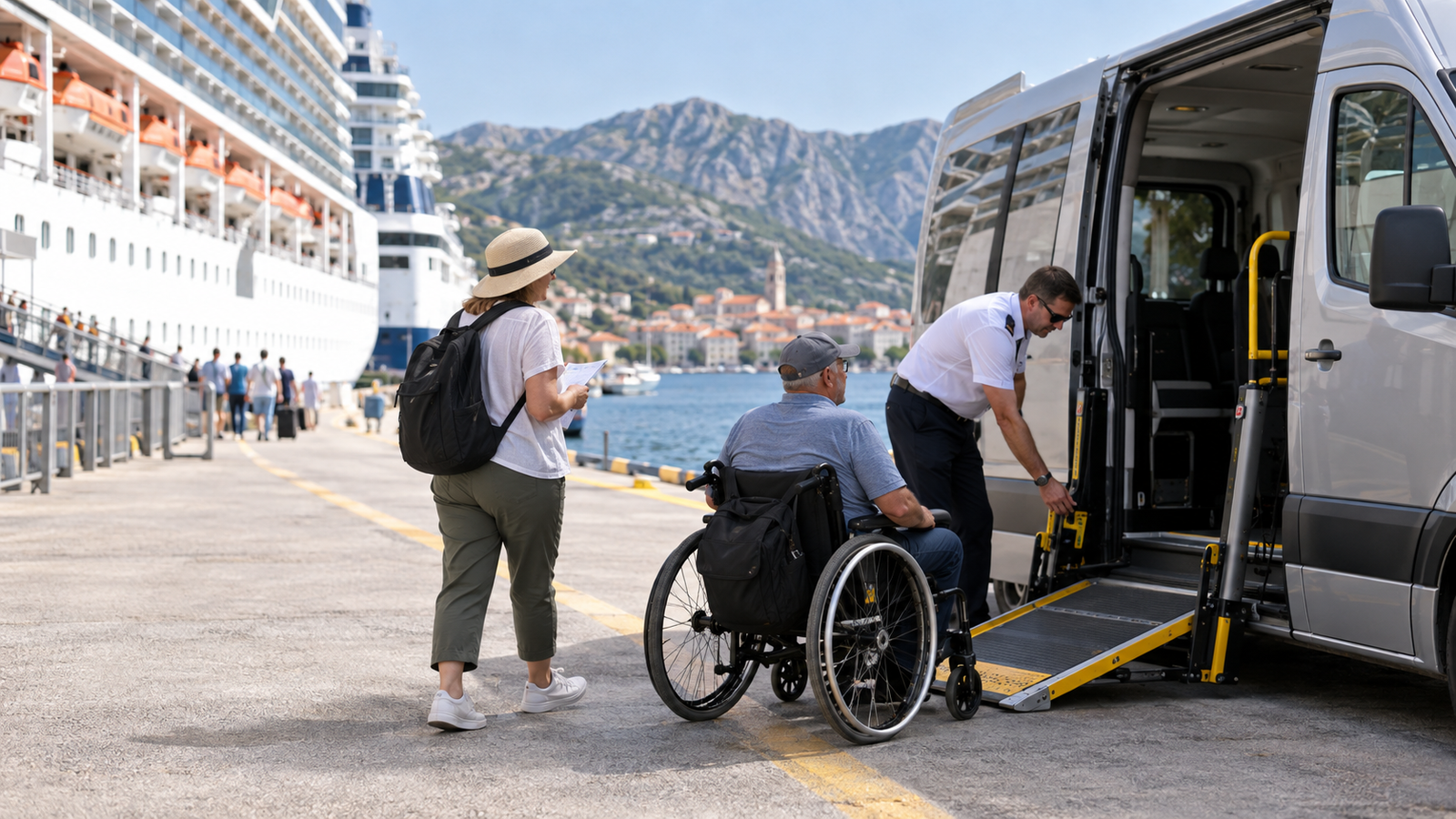
| Does the vehicle have a lift or ramp? | Type, capacity and whether it is confirmed for your departure |
| How is the chair secured? | Securement method and whether space is reserved |
| What surfaces will I encounter? | Cobblestones, gravel, sand, steep grades, boardwalks, grass or uneven historic surfaces |
| Are there unavoidable steps? | Where they occur and whether an alternative route exists |
| Is an accessible restroom available? | Location and whether it is available during the full excursion |
| Can a companion assist? | Whether assistance is permitted/required and whether the companion pays full price |
Tender and gangway questions come before the tour
Even a fully adapted excursion is unusable if the traveler cannot get from the ship to the meeting point. Ask the cruise line—not only the tour seller—how shore access works for the exact sailing.
- Does the ship dock or tender at this port?
- Can my exact chair/scooter be carried on the tender used for this call?
- Is a transfer from chair to tender seat required?
- What happens if sea conditions make tender boarding unsafe?
- Is there an accessible route from the gangway/tender landing to the excursion meeting point?
- Does the port provide an accessible shuttle or must the operator enter the terminal area?
Do not treat a tender decision as a tour-operator promise
Ship and port operations can determine whether a traveler can get ashore. Obtain the cruise line’s current accessibility guidance for the actual vessel and port call.
Vehicle questions should be specific enough to prevent substitution problems
A written “yes, accessible” is still too vague. Ask what vehicle is planned and what happens if that vehicle is unavailable on the day.
- Vehicle make/type if known
- Lift/ramp dimensions and weight limit
- Interior height and securement space
- Whether the traveler can remain in the chair while driving
- Maximum number of mobility devices carried
- Whether a last-minute vehicle substitution is possible
- What refund or alternative applies if the confirmed accessible vehicle is not provided
Ask about the route, not just the transport
Historic Mediterranean centers, beaches, archaeological sites and older buildings can create very different barriers. An adapted van does not guarantee an adapted attraction.
Ask the operator to describe the least accessible point on the itinerary. That question often produces a more useful answer than “Is the tour accessible?”
Useful wording: “Please identify any steps, steep slopes, cobblestones, gravel, sand, narrow doorways, inaccessible restrooms, required transfers or locations my chair cannot reach.”
Keep a written response log
| Item | Your record |
|---|---|
| Traveler/device | Type: ___ / width: ___ / length: ___ / total weight: ___ |
| Transfer ability | Independent / assisted / cannot transfer |
| Cruise line confirmation | Date / contact / ship-to-shore answer |
| Tour seller confirmation | Date / contact / listing |
| Local operator confirmation | Date / contact / vehicle / route |
| Accessible restroom | Confirmed / not confirmed / location |
| Fallback plan | Alternative excursion / stay near port / ship option |
How to use Shore Excursions Group accessibility information
SEG does publish listing-specific restrictions and, on some tours, meaningful accessibility details. That is useful evidence, but availability can still be operator- and vehicle-specific. When the listing says “upon request,” treat the request as incomplete until you receive confirmation for your booking.
For a traveler with a complex mobility requirement, the safest workflow is: cruise line/port access first, then listing review, then written seller/operator confirmation.
Only book after the exact mobility requirement is confirmed
If a SEG listing appears suitable, use it as the starting point and confirm the vehicle, transfer and route details for your departure before payment becomes non-refundable.
Check current Shore Excursions Group listings for your sailing
Sources and freshness
This checklist was checked September 20, 2026 against multiple current Shore Excursions Group listings showing materially different wheelchair/scooter/transfer conditions, including current Roatán, Liverpool and private Pompeii examples, plus SEG’s accessibility-focused editorial material. Because vehicles, tenders and operator assignments can change, obtain written confirmation for the exact sailing and traveler rather than relying on this page as a suitability determination.