
Affiliate note: Some links on this page are affiliate links. If you book through them, BookOutdoorTrips may earn a commission at no extra cost to you. This does not affect our editorial judgment. Learn more.
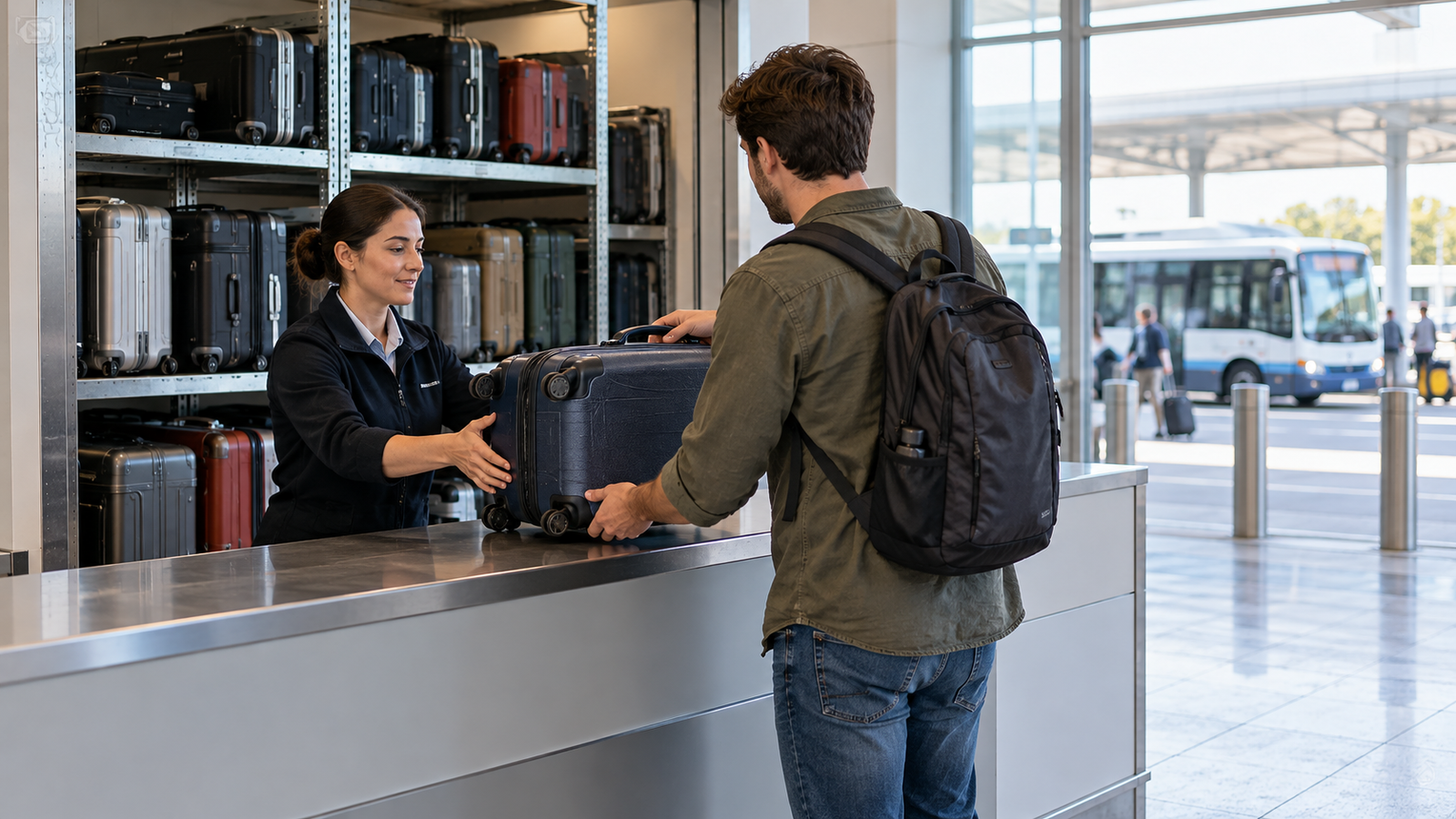
You can store luggage at some airports, but not every airport offers lockers or a staffed baggage desk—and “near airport” can mean outside the terminal entirely. During a layover, use a terminal facility when you need a simple in-and-out collection, or consider off-site storage only if lawful entry, transport, opening hours and security re-entry leave meaningful time. For a short or uncertain connection, keeping your bags with you or using the airline’s checked-baggage arrangements may be better.
Airport luggage storage is a location-and-timing problem, not merely a price comparison. Before booking anything, determine whether the bag is available to you, whether storage is before or after airport security, and whether you can realistically collect it before boarding.
First, know which kind of storage you need
| Option | Can make sense when… | Hidden constraint to check |
|---|---|---|
| Airside locker (past security) | You stay in the secure transfer area and hold small carry-on items. | Access restrictions; may be unsuitable for a city visit or later retrieval from landside. |
| Landside airport baggage desk | You want to leave the terminal and return without an extra off-airport detour. | Terminal, counter opening hours, bag size, security screening and line at collection. |
| Off-site storage partner | You plan a longer trip into town and a real host lies on your outward and return route. | Actual street address, transport time and business closing before your flight. |
| Hotel or existing accommodation | You will pass the property again and it agrees to hold the bags. | Guest eligibility, staff hours and extra backtracking. |
| Keep luggage / airline handling | Your connection is short or baggage is already checked through. | Which bags you will physically have and what your airline requires at transfer. |
Real airports show why a universal answer fails
San Francisco International (SFO): The airport’s official baggage storage FAQ identifies the Airport Travel Agency on the International Terminal departures/ticketing level, near the G-gates entrance, as its baggage-storage service. It describes daily operation from 6 a.m. to 11 p.m., luggage X-ray before storage and 24-hour-based size-dependent rates. That is a real airport service—not an affiliate host assumed to be inside a terminal. Confirm live hours and charges directly before relying on it.
Amsterdam Schiphol (AMS): The airport’s official storage guide separates small-item lockers after security in transfer areas from a baggage-storage counter before security at Arrivals, level −1 between Arrivals 1 and 2. Schiphol states the arrivals storage counter operates 24/7 and warns that retrieving items landside after clearing security is difficult. The airside-vs-landside distinction can matter more than the apparent locker price.
London Heathrow (LHR): The airport’s luggage storage page confirms an on-airport service run by Excess Baggage Company, with published duration-based charges. It is a separately operated paid service, so verify your terminal’s desk and opening hours rather than assuming any airport-wide 24-hour counter.
These are examples with inspected official airport pages, not a global directory or a promise that every airport offers the same service. Conversely, a marketplace search result labeled with an airport name is not proof of a storage point within any airport’s secure or public terminal areas.
How to tell if a layover can support off-site storage
Start with your scheduled gate-to-gate interval, then subtract the time you cannot actually spend outside. A practical planning identity is:
Usable city time = layover time − arrival/disembarkation and border processing − outward transport − bag drop-off − return transport (including bag pickup) − required airport re-entry, security and boarding buffer.
Each term depends on the airport, nationality, airline, terminal, day and route. This is a decision method, not a fixed airport transfer-time claim. If any important term is unknown, treat the result as uncertain rather than assigning an optimistic number.
For illustration only: a traveler with an eight-hour scheduled connection who allocates one hour to arriving and formalities, 90 minutes to the outward trip and drop-off, 90 minutes to collection and return, and two hours for airport re-entry and boarding has two hours left. Those are hypothetical planning allowances—not verified conditions at SFO, Schiphol or Heathrow. One delayed arrival, immigration queue or closed shop could erase that sightseeing window.
Can you legally leave the airport?
Do not treat an airline connection as automatic permission to enter the country. Requirements depend on citizenship, entry documents and transit circumstances. For example, the U.S. Department of State’s official transit visa guidance distinguishes immediate continuous transit from sightseeing during a layover. It explains that sightseeing generally requires a visitor-appropriate visa category or a qualifying waiver arrangement, not merely a transit purpose. Check your own nationality, documentation and destination rules through the relevant government before planning a city visit.
Even if entry is permitted, leaving a secure transit zone may require a separate re-entry and security check. A checked-through bag is not necessarily available at an intermediate stop; your airline’s baggage routing and customs instructions control whether you can retrieve it. Confirm this before purchasing storage you might not use.
Airport desk or local storage partner: which route costs less time?
If you plan to return by exactly the same terminal, landside airport storage can minimize the number of handovers and detours. If you are visiting the city and leaving from a central station or different travel hub, storage on that path may save a return to the airport before you actually need one. Do not make that judgment from straight-line map distance.
In an off-site marketplace, the operator of the shop or hotel physically holds your bag. Radical Storage’s official booking instructions say the exact address and host details are supplied after booking, and collection depends on the local host. “Airport area” is therefore a search label, not a confirmation of terminal access. Allow time for street navigation, handover and the possibility that a published opening schedule is not honored.
| If this is your actual route… | First option to investigate | Reason |
|---|---|---|
| Terminal → brief wait → same-terminal departure | Airport desk if one exists, or keep accessible cabin bags. | A cross-town trip adds failure points without much reward. |
| Terminal → long city visit → return to terminal | Landside airport desk versus a host on the transit corridor. | Compare two full round-trip paths, not advertised bag rates alone. |
| Hotel checkout → city activities → airport later | Hotel bag hold or a host on the last airport-bound route. | Do not return to a distant hotel solely for baggage if another safe choice fits. |
| International connection requiring an entry decision | Government entry rules and airline transfer instructions first. | No storage booking solves an immigration or baggage-availability restriction. |
Compare total money and exposure, not teaser rates
For an airport desk, ask whether the price covers three hours, a calendar day or each 24-hour period, and whether large bags cost extra. SFO explicitly describes size-based 24-hour assessment in its airport FAQ; Heathrow publishes separate duration bands. For an off-site host, record the exact checkout total for your number of bags and selected dates, any service or protection fee, and the cost of extra transport. Do not compare Heathrow pounds, Schiphol euros and a U.S. marketplace’s dollars as if they were directly comparable without a dated currency conversion.
There is also a non-monetary cost: an inaccessible bag near boarding can put the flight at risk. The economical option is the one that fits the full travel chain with adequate margin, not necessarily the smallest displayed storage charge.
When an off-site booking is reasonable
A marketplace can help when the airport has no suitable counter, you have a long legal layover, and an open host lies naturally along the trip. Before paying, confirm the local address, collection hours, latest arrival you can tolerate and final payable price. Keep passports, medication and any irreplaceable documents or electronics with you; the Radical Storage traveler terms contain item exclusions and conditions that should not be mistaken for universal insurance.
Disclosure: BookOutdoorTrips may earn a commission if you book through our Radical Storage link. Official airport facilities and other alternatives are discussed independently.
If off-site storage passes your route and time checks, you may browse Radical Storage locations and verify the exact service area. The link is to its general booking homepage; it does not select an airport, claim a terminal location or guarantee a host.
A pre-booking checklist for a real layover
- Confirm the bag is yours to collect: cabin luggage, checked-through baggage or a customs re-check situation.
- Verify legal entry or secure-transit restrictions for your own passport and itinerary.
- Check the airport’s official map for landside versus airside storage and the exact terminal.
- Read the operator’s current opening hours, size restrictions, price basis and receipt/collection procedure.
- Plot every required transport leg, using same-day schedules, possible queues and an arrival buffer set by your airline.
- Prefer a location you can collect from even when the flight, train or planned attraction is delayed.
- Retain bag identification, booking receipt, photos and support details. Do not leave essential documents in stored luggage.
Bottom line
For a short connection, simplicity is a real benefit: keep your belongings with you or use an accessible airport service when available. For a long sightseeing stop, an off-site host can work—but only if entry status, transit, bag custody and return timing all align. Verify the actual terminal and host for the date of travel; an airport name on a storage landing page is not evidence of an airport-terminal service.
Official airport services, U.S. transit guidance and Radical Storage process/terms checked October 13, 2026. Airport counters, prices, immigration rules, terminal access and baggage transfer conditions must be rechecked for the actual itinerary.