
Affiliate note: Some links on this page are affiliate links. If you book through them, BookOutdoorTrips may earn a commission at no extra cost to you. This does not affect our editorial judgment. Learn more.
Quick answer — where should you leave your bags?
Ask your accommodation about a bag hold first if you will return there. If you leave by rail, check the actual station’s temporary-storage service; if the route ends elsewhere, compare a staffed local host or an appropriately accessible locker. The right luggage storage option is one you can collect from before your next departure, with room for delays, acceptable bag rules and a total cost you can verify.
Luggage storage is not one uniform product. A hotel bell desk, an operator-run station counter, a self-service locker and a shop booked through an app can solve different parts of the same travel day. Their opening hours, access rules and responsibility for your suitcase also differ.
This guide is a method-selection hub for travelers planning gaps before check-in, after checkout or between connections. It does not claim to show live availability or a cheapest location for any city. For specific merchant trust questions, see our Radical Storage review.
Five storage methods, compared by the decision that matters
Match a storage method to the trip, not to a brand name
| Option | When it tends to fit | Critical check |
|---|---|---|
| {escape(cell)} | {escape(cell)} | {escape(cell)} |
| {escape(cell)} | {escape(cell)} | {escape(cell)} |
| {escape(cell)} | {escape(cell)} | {escape(cell)} |
| {escape(cell)} | {escape(cell)} | {escape(cell)} |
| {escape(cell)} | {escape(cell)} | {escape(cell)} |
“At the station” is not the same as “a locker inside the station.” Likewise, a map listing near an airport or station is not proof that a luggage counter operates within the terminal. For confirmed facilities, the station, airport or transport operator is the governing source.
Plan backwards from collection, not forwards from drop-off
Start with the exact place and time you must next reach: a platform, airport terminal, coach stand or accommodation check-in. Then trace your pickup location → onward travel → departure route. Allow for retrieving a tagged bag, locating the correct entrance and the travel or check-in procedures of your carrier. An attractive storage pin near your morning arrival can be the wrong option if you finish the day across town.
The return-route test
A choice is viable only if the host/counter remains accessible through your realistic pickup time and the remainder of the journey still allows you to meet your carrier’s own boarding or check-in requirement. If missing the collection window means losing your flight or train, reject the option even when its displayed storage rate is low.
Treat a predicted walking time as a planning input, not a guaranteed transfer. Recheck the actual entrance, accessible route, public-transport timetable and station layout before committing. A flexible day in a walkable city tolerates much more pickup uncertainty than a short flight connection.
Before hotel check-in and after checkout: ask the property first
A hotel bag hold can avoid a second booking entirely when you will return to the same property. Its availability is property-specific, not a universal entitlement. As an explicit example, Park Hyatt Saigon’s own FAQs say that its bell desk offers complimentary storage before check-in and after checkout. That is the policy of that named hotel, not evidence that every Hyatt or every accommodation will do the same.
Ask the property four precise questions: Will it hold bags for guests before arrival or after checkout? Is there a charge, size restriction or same-day collection limit? Is the desk staffed at the time you will return? What receipt or identification is required? If the hotel is far from your evening terminal, “free” may be less convenient than a paid point near departure.
Station baggage storage and lockers are not interchangeable
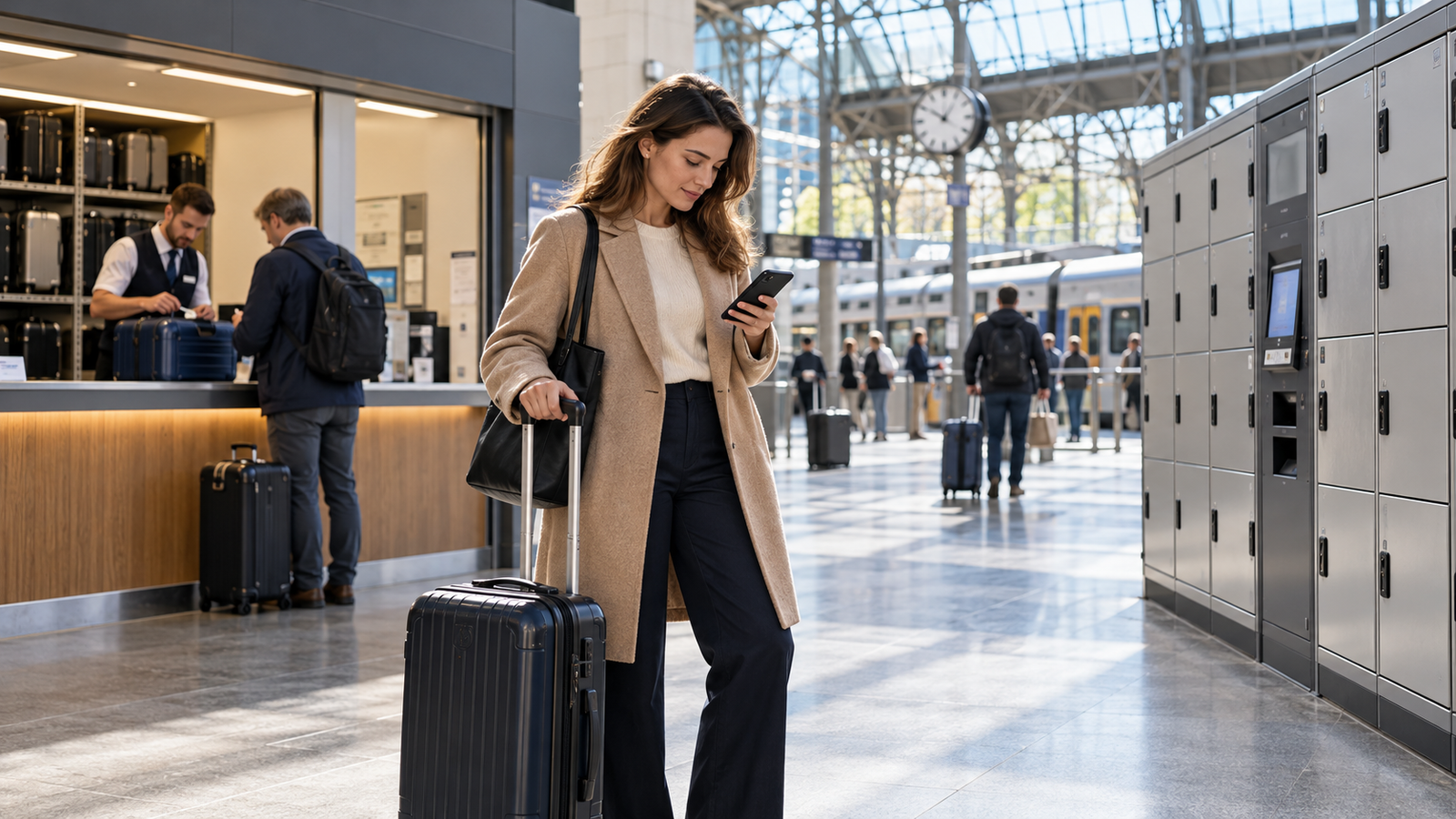
A staffed railway left-luggage service may issue a claim receipt, have defined counter hours and distinguish a ticketed passenger from a member of the public. An unattended locker instead depends on compartment size, access instructions and the building or operator’s opening times. Do not infer one service exists merely because another station has it.
For a concrete U.S. example, Amtrak’s At-Station Baggage Services page publishes temporary-storage rates of $20 per item per 24-hour period for Amtrak customers with a valid ticket and $30 for the general public with valid photo ID at participating staffed stations. Amtrak expressly directs travelers to check the individual station for service availability; these are published program rates, not a quote or acceptance guarantee for a particular future trip. A checked bag that travels on a train is a different service from temporary storage.
Lockers can simplify custody where an appropriately sized, accessible unit actually exists. But do not assume every rail or airport facility provides them, that they operate around the clock, or that all bag dimensions fit. The most reliable way to choose is to inspect the named operator’s rules, not the generic phrase “luggage lockers near me.”
Booking an independent host through an app
Third-party storage networks are particularly useful when a station has no convenient service or when your ideal pickup neighborhood is away from the accommodation. The crucial unit of comparison is the individual physical host, not a global brand score. Check whether it is a hotel, shop or a locker, what hours it is actually accessible, and whether your bags satisfy the provider’s permitted-item rules.
For example, Radical Storage’s official booking walkthrough says its partner’s business name, complete address and contact details are provided after booking, with a QR-code confirmation, handover process and drop-off receipt. This is evidence for the workflow; it is not proof that a chosen partner will be open on your date. The Radical Storage traveler terms identify the local “Angel” as the usual physical storage provider and set exclusions for items including technological devices and important documents.
Important: protection is not a reason to leave essentials in a bag
Do not treat a platform’s headline guarantee as automatic insurance or as compensation for a missed flight. Keep passports, medication, important documents, payment cards and essential electronics with you. Check the actual provider’s current prohibited-items list, guarantee conditions and claim deadlines before leaving a bag.
If comparing two platforms rather than choosing a storage method, use the same destination, date, bag count and return time. Check each platform’s current cancellation wording, including Bounce’s official terms and Radical Storage’s official terms. Refund policies can change: use the version displayed at checkout rather than relying on an undated comparison.
What luggage storage actually costs
A meaningful cost comparison starts with the same number and type of bags and the same pickup time. A public rate at a staffed rail counter may differ from the price for a ticketed passenger. An app’s per-bag/day listing may also have payment-stage additions. A hotel may waive the storage charge but require a detour to retrieve your bags.
Compare: amount due at the provider’s checkout or counter + any additional transit you will really take + the inconvenience of getting bags back before departure. The last element is not a monetary quote: it is a risk that can outweigh a small advertised saving. No matched-date marketplace checkout totals were independently obtained for this general guide, so no universal price winner is asserted.
Choose differently for three common travel gaps
A morning arrival before the room is ready
First contact the booked hotel or accommodation and ask about a guest bag hold. If it is offered and your day ends near the hotel, that often avoids a separate paid booking. If you will spend the day by a different transport hub, compare storage on that route instead of automatically returning to the hotel.
Checkout at noon, train in the evening
A station desk can be practical when your evening train departs from that same station—provided it actually accepts temporary bags during the full required window. A nearby shop could work equally well if the door-to-platform walk and closing time meet your margin. Verify the station operator and departure terminal separately.
A short stop between flights
First establish whether your baggage is checked through, whether you are allowed and able to retrieve it, and whether you must pass immigration, security or a terminal transfer. A supposedly nearby city host is not a substitute for an on-airport facility; its round-trip journey can consume the connection. Our airport luggage-storage guide tackles that separate access problem.
If the host or storage desk cannot take your bags
Do not leave luggage unattended, pay an unlisted third party or assume another location must honor your reservation. Check the confirmed address and opening window, keep photographs or screenshots of the booking and refusal, and contact the operator or booking platform through its documented support channel. If the reservation cannot be fulfilled, ask about a feasible substitute on your actual route and the appropriate refund process. A later refund does not fix a missed departure.
If a store has unexpectedly closed, consider a confirmed hotel or staffed station alternative before making further travel arrangements. For city-specific pickup planning rather than a general-method comparison, our Boston guide, Chicago guide and Los Angeles guide address their own route and station decisions.
The final seven-point storage checklist
- Name your actual departure platform, terminal or final pickup destination.
- Ask your accommodation whether it accepts guests’ bags and when the desk closes.
- For a station, verify temporary storage separately from train checked baggage or locker advertising.
- Compare the collection detour and counter/host hours before comparing displayed prices.
- Count every bag, read permitted-item and size rules, and keep valuables and essentials with you.
- Check the final charge, cancellation method, receipt and named operator’s customer-support process.
- Leave a realistic buffer for retrieval, station access and transport; recheck details for the actual date.
For a flexible local-shopping day, a suitable verified partner may make sense. If the entire itinerary depends on one short closing window, prioritize a staffed facility with a safer return route—or keep your luggage with you. When all available third-party options would require dangerous backtracking or unreliable pickup, not booking storage can be the better travel decision.
Affiliate disclosure: This guide includes a Radical Storage booking link. If you make a qualifying booking through it, BookOutdoorTrips may earn a commission. Our choice framework includes non-affiliate alternatives.
If a booked local host fits your collection route and bag requirements, you can compare available options and the current checkout total directly:
Check Radical Storage locations and prices →
Research and limits — reviewed 23 October 2026
This guide uses official property, station and merchant information and the BookOutdoorTrips destination-specific guides linked above. Amtrak figures describe its published U.S. station program; Park Hyatt Saigon illustrates one property’s policy. No live inventory, exact individual host, same-date provider quotes, travel-time measurement or actual booking was verified. Recheck the operator’s current rules before paying.